
Why Helical Tieback Anchors Are the Strongest Fix for Failing Panhandle Seawalls
You're walking your seawall and something feels off. The wall has a lean that wasn't there last year, or you can see daylight between the cap and the top of the sheet pile. Those aren't cosmetic issues — they're structural signals that your anchoring system is failing. This post explains why Florida Panhandle seawalls fail at the anchor point, how helical tieback anchors fix it, and what makes them the better choice for Emerald Coast conditions than traditional dead man replacement.

Property Image crew installing CHANCE helical tieback anchors in a Florida Panhandle seawall repair project
Already know you need help? Call Property Image at 850.374.8203 — we serve Fort Walton Beach, Destin, Miramar Beach, and the entire Florida Panhandle.
Why Seawalls Fail — What's Actually Happening Underground
Most seawall failures start long before the wall visibly moves. Traditional construction buries concrete dead man anchors in the soil behind the wall, connected to the wall face by steel tie rods. When everything's new, that system holds.
Then saltwater chemistry gets involved. Tie rods corrode in the wet, oxygen-rich soils common along the Gulf Coast, losing cross-sectional strength until they can't carry the design load anymore.
Meanwhile, the sandy saturated soils behind the wall shift, sometimes moving the dead man block itself. The wall leans toward the water. That lean increases lateral pressure, and by the time you see movement from your dock, the anchoring system is already compromised.

A Florida Panhandle seawall after threaded rod anchors failed — the wall is visibly bowing toward the water and was closed for safety. This is what anchor system failure looks like before repair.
How Helical Tieback Anchors Stop the Movement
A helical tieback anchor is a galvanized steel shaft with large helical bearing plates welded along its length. A hydraulic torque motor — mounted to a compact excavator — screws it into the ground until the plates reach stable bearing strata well past the wall's failure plane.
Once at depth, each anchor connects to the seawall face through a waler system — a horizontal beam distributing load across multiple points. Tensioned against the wall, those anchors pull it back toward its design position and hold it there.
Installation torque is monitored throughout, giving engineers a verified load capacity reading before the wall's ever tensioned. You know it's working before the job is done — not after.

The same seawall after Property Image replaced all failing tiebacks with CHANCE helical anchors — wall pulled back to plumb, new boardwalk cap installed, ready for use.
What Makes Florida Panhandle Soils Demand a Different Anchoring Approach?
Sandy Gulf Coast soils across the Panhandle have high water tables and variable bearing strata. Near the surface those soils are often loose — which is exactly why dead man anchors shift over time. The denser layers that actually support helical tieback anchor loads are deeper, and the only reliable way to reach them is to install to depth.
CHANCE anchors are built for exactly this condition. Installation continues until torque readings confirm the helices have found adequate bearing — whether that's 12 feet down or 20. Depth is driven by the soil, not by a preset number, so load capacity is site-verified rather than estimated from a report alone.
CHANCE® anchors are hot-dip galvanized steel, engineered for the saltwater chemistry that destroys conventional tie rods in coastal environments like Fort Walton Beach, Destin, and Niceville.
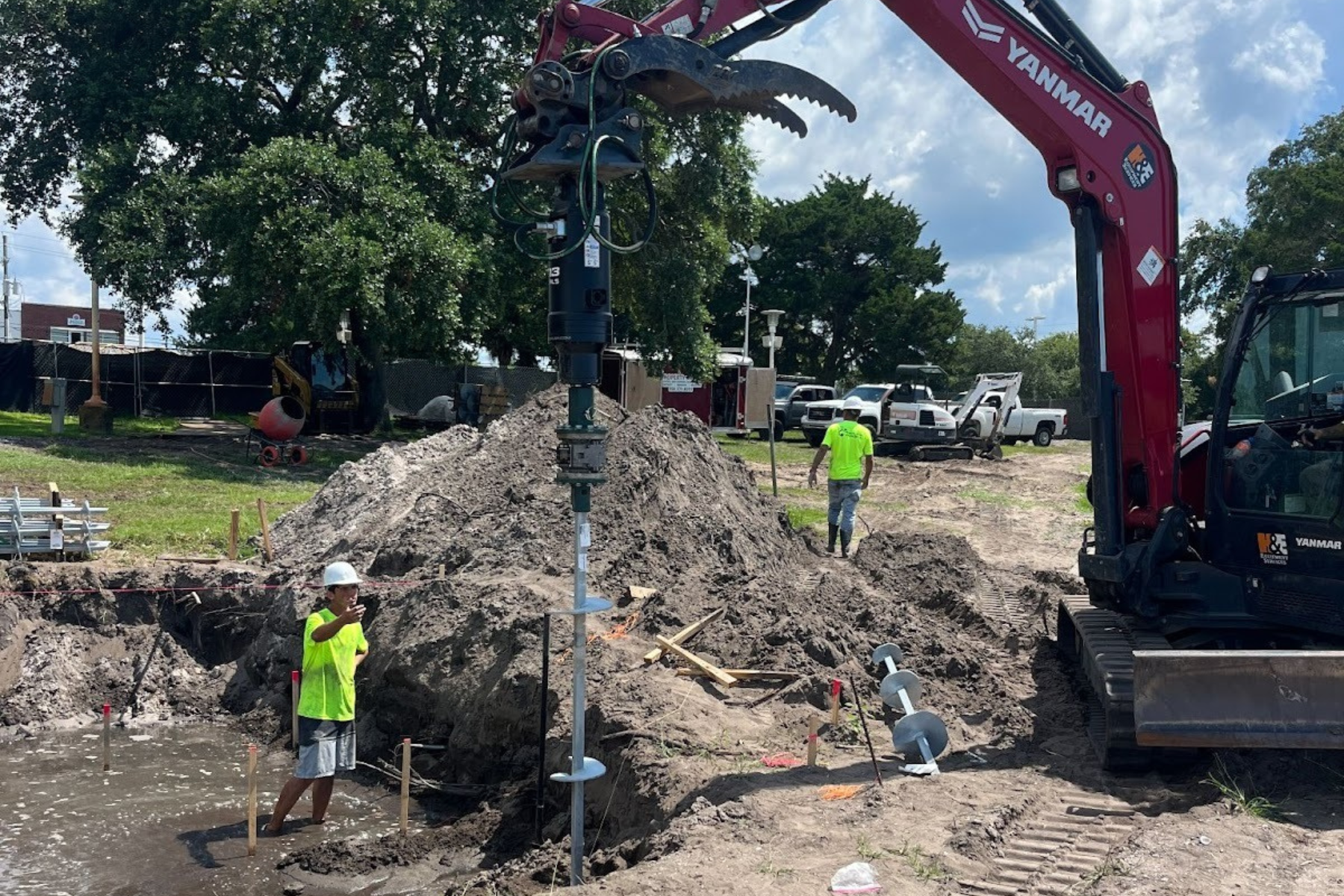
The hydraulic torque motor advances the helical anchor until torque readings confirm it's reached stable bearing strata — no guessing, no estimating.
Helical Tieback Anchors vs. Dead Man Replacement — the Practical Difference
Replacing dead man anchors means excavating behind the wall — disturbing landscaping, hardscape, or whatever sits on the land side of your seawall. In a finished waterfront yard anywhere from Navarre to Miramar Beach, that excavation's disruptive and expensive before anchor work even starts. Concrete dead men also require days to cure before the wall can be tensioned.
With compact equipment, helical tieback anchors install from the water side or land side — no mass excavation. They reach design depth in hours and the wall can be tensioned the same day.
Long-term, galvanized helical anchors outperform steel tie rods in saltwater soils. The anchor head's accessible for future inspection — something buried concrete dead men simply don't allow.
Concerned about your seawall's anchor condition? See Property Image's full helical anchor services across the Florida Panhandle or call 850.374.8203.
Signs Your Seawall Needs Tieback Reinforcement
Not every seawall needs helical tieback anchor work — but these signs point specifically to anchor system failure rather than surface deterioration:
Visible lean toward the water, especially if the wall top has moved more than the base
Horizontal cracking at or near tie rod connection points
Separation between the seawall cap and the top of the sheet pile
Soil erosion or voids forming behind the wall
Wall movement that accelerates after rain or storm events
Surface cracking without movement may point to concrete deterioration or drainage issues instead. Either way, if you're seeing visible movement it's a signal for a structural assessment to determine whether helical tieback anchor reinforcement is the right fix — not surface patching.
Beyond Seawalls — Helical Anchors for Footings and Underpinning
Property Image has also installed CHANCE helical pile systems as structural footings — including for an amphitheater where high water tables and site access made conventional concrete piers impractical. These are the same helical tieback anchor principles applied vertically rather than horizontally, carrying compressive loads from structures above down to stable bearing strata with no excavation, no dewatering, and immediate proof-testing.
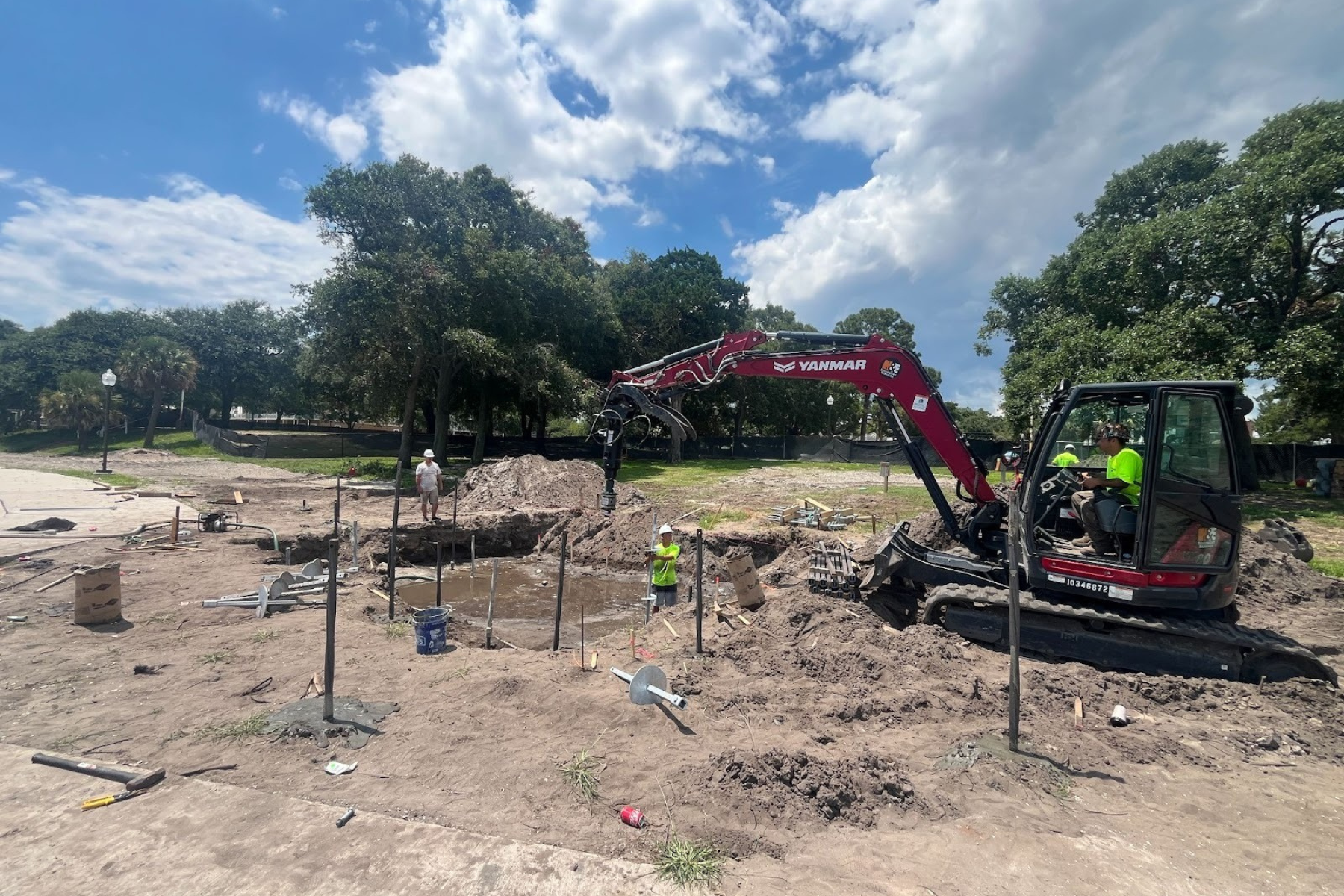
Property Image installing CHANCE helical piles as structural footings — the same anchor system used for seawall tiebacks, applied vertically for compressive foundation loads.
For full technical specifications on shaft configurations, helix plate sizing, and load capacity, see CHANCE Helical Anchors: Ground Screw Foundation Anchors from Foundation Technologies.
Property Image has 25+ years of marine construction experience across the Florida Panhandle. Our team's trained specifically for helical tieback anchor installation in seawall, footing, and underpinning applications — and we're not general contractors who occasionally work near water.
Ready to assess your seawall? Visit our helical anchor service page or call 850.374.8203 to schedule a site assessment.