
Wood vs Vinyl vs FRP vs Steel Seawalls: How to Choose the Right Option for Your Waterfront Property
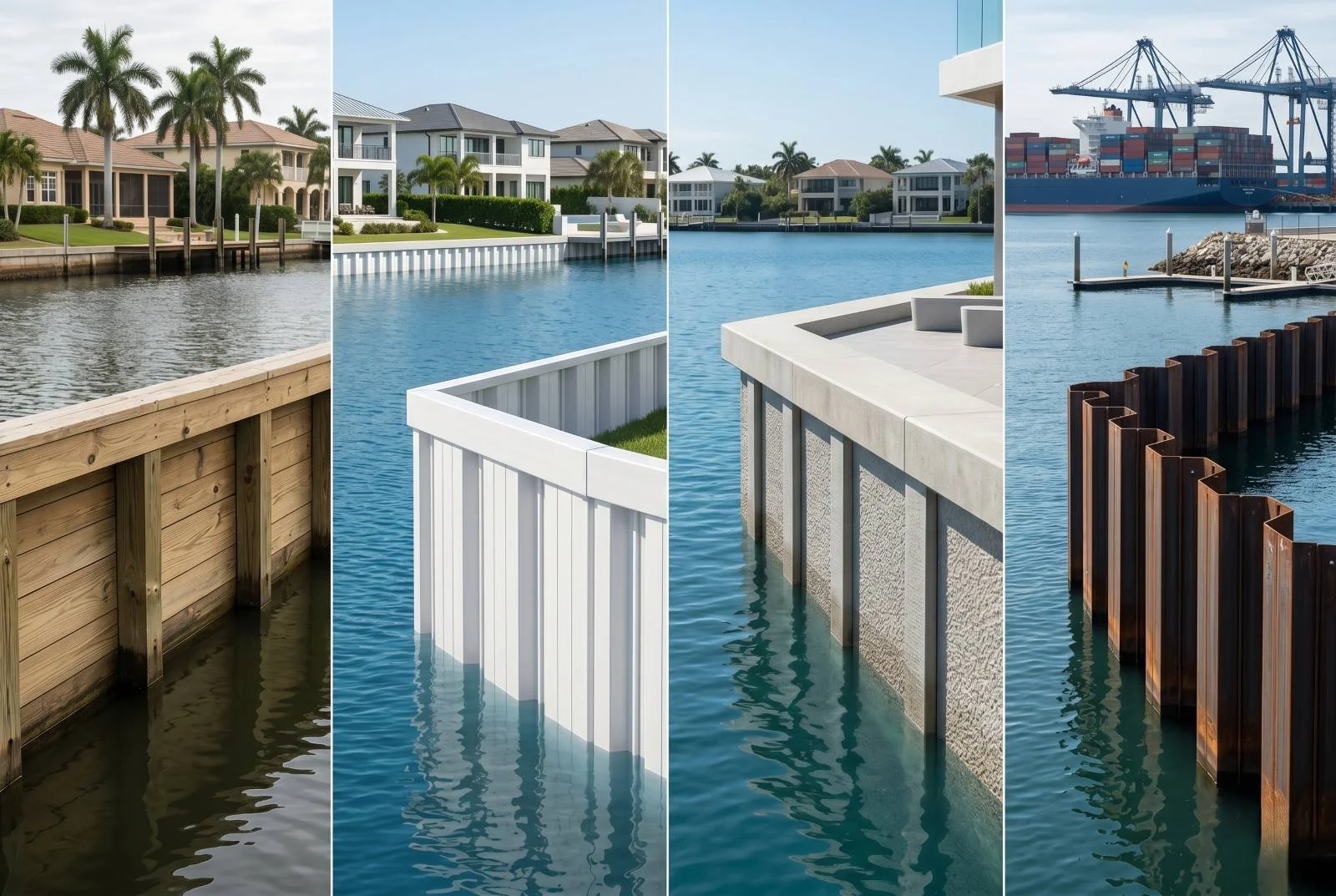
Comparing wood vs vinyl vs FRP vs steel seawalls comes down to four variables: wall height, wave and surge exposure, maintenance tolerance, and how long you plan to hold the property. Each material has a clear performance window — and a clear failure mode when it's pushed outside that window. This post breaks down exactly how all four perform in the saltwater environment around Fort Walton Beach, Destin, and the wider Emerald Coast, so you can walk into a contractor conversation knowing the right questions to ask.
Ready to talk through your specific property? Contact Property Image for a free waterfront assessment — 850.374.8203.
Why Fort Walton Beach Is One of the Hardest Environments for Seawalls
Fort Walton Beach doesn't give seawall materials an easy life. Open Gulf waters exceed 30 ppt salinity, while the region's bays and estuarine systems — Choctawhatchee Bay, Santa Rosa Sound — run 20–30 ppt depending on freshwater input. Those conditions support active marine borer populations year-round, with no cold-weather reprieve you'd get in the mid-Atlantic or New England.
Storm surge compounds the challenge. According to theUSGS post-storm survey, Hurricane Michael produced a measured storm tide of 15.55 feet at Mexico Beach in 2018, with peak storm surge of 9–14 feet along the coast. The Panhandle's shallow continental shelf and concave coastline geometry are responsible — they funnel and amplify surge in ways that flat, open coastlines don't.
Add relentless UV exposure and the unconsolidated quartz sands typical of Northwest Florida (poor passive earth pressure resistance, high susceptibility to toe scour), and you have an environment that exposes the specific weaknesses of every material on this list.
Wood vs Vinyl vs FRP vs Steel Seawalls: Which Material Fits Which Property?
Short answer: wood fits protected canals on a budget; vinyl fits bay-side residential walls under 7 feet; FRP fits mid-height walls where vinyl falls short and steel's maintenance burden is prohibitive; steel fits tall walls, open water, and commercial applications. Your specific site determines which one actually applies — which is why the breakdown below matters.
Wood Seawalls: Where They Work and Where They Don't
Pressure-treated Southern Yellow Pine (SYP) is the traditional choice for Gulf Coast marine construction. The critical specification is CCA (Chromated Copper Arsenate) treatment at 2.5 pcf retention — the AWPA Use Category UC5B minimum for saltwater immersion. This matters more than most property owners realize: ACQ and Copper Azole treatments are not rated for saltwater and should only appear on above-waterline components. TheUSACE design manual for coastal structures (EM 1110-2-1614) covers material selection criteria for exactly these conditions.
In Florida Gulf Coast waters, properly treated CCA pilings typically last 25–35 years, extendable to roughly 40 years with vinyl pile wraps and piling caps. Without proper treatment, marine borers can destroy pine pilings in 1–3 years in warm Gulf waters — borers are active year-round here, unlike temperate zones where cold winters slow them down.
Above the waterline, the splash zone — where wood cycles between wet and dry — is the primary failure zone for fungal decay. Fully submerged wood resists rot but remains vulnerable to borers. Common failure modes also include fastener corrosion from incompatible metals reacting with copper-based preservatives, and hydrostatic pressure buildup behind the wall from clogged weep holes — the most common cause of wood seawall displacement.
Installed cost: $150–$500 per linear foot. Requires annual inspection and more frequent maintenance than synthetic alternatives.
Best fit: Protected canal and bay-side residential properties with moderate budgets and owners willing to commit to annual maintenance. Not appropriate for open Gulf exposure or high-energy sites.
Vinyl Seawalls: Low Maintenance, Structural Limits
Vinyl sheet piling has been installed in marine environments since the mid-1980s, with manufacturers now offering 50-year warranties. Practical field estimates for saltwater installations run 30–50 years. Modern marine-grade vinyl uses co-extruded UV-stabilized cap stock over a PVC core — USACE-funded research (ERDC/CRREL Report LR-03-19) found that UV degradation is limited to roughly 150 micrometers of surface depth, with flexural and tensile properties remaining stable after 5 years of outdoor Florida exposure.
Structurally, PVC has a modulus of elasticity roughly 1/60th that of steel, restricting cantilevered applications to approximately 6–7 feet of exposed wall height. Taller installations require tiebacks, walers, or hybrid designs. For the Panhandle's canal and bay-side properties, that height range is usually sufficient.
For open Gulf-facing sites whereFEMA's November 2024 coastal structures guidance defaults to assuming open-coast bulkheads fail during a 1%-annual-chance flood event, vinyl alone doesn't provide adequate structural capacity. That's the clearest signal for when to move up to FRP or steel.
Vinyl seawalls are completely immune to corrosion, marine borers, and rot. Failure modes are UV embrittlement over decades, creep under sustained load, and impact damage from boats or storm debris.
Installed cost: Florida Gulf Coast saltwater residential applications typically run $700–$1,200 per linear foot when permitting, engineering, and site-specific conditions are factored in. Maintenance is near zero beyond annual visual inspection and post-storm checks.
Best fit: Canal and bay-side residential seawalls under 7 feet of exposed wall height. Strong choice for property owners prioritizing a long, low-maintenance ownership horizon.
FRP Composite Seawalls: The Emerging Middle Ground
FRP (fiberglass reinforced polymer) sheet piling fills the structural gap between vinyl and steel. With a modulus of elasticity of 2.0–4.4 million psi — roughly 5–10 times that of PVC — FRP is cost-competitive for wall heights between 6 and 18 feet. That's the range where vinyl can't reach high enough and steel's corrosion management burden starts driving lifecycle costs past the point of practical justification for residential owners.
Manufacturers claim service lives of 75+ years, supported by USACE demonstration projects with 10+ years of maintenance-free performance. Worth noting: the longest field installations are around 20 years old, so the 75-year figures rely on accelerated aging data and material modeling rather than direct observation. For aggressive saltwater environments, vinylester resin is preferred over polyester for superior hydrolytic resistance.
FRP seawall panels weigh 60–70% less than comparable steel sections, reducing installation costs meaningfully. The material is immune to corrosion, rot, and marine borers. The primary engineering caution is local compression buckling of thin-walled sections — failure occurs well before ultimate material strength is reached, requiring specific buckling analysis rather than simple stress calculations. TheUSACE EM 1110-2-1614 provides the structural design framework engineers reference for all sheet piling types including composites.
Installed cost: Manufacturers direct inquiries to project-specific quotes. Most cost-competitive in the 6–10 foot wall height range.
Best fit: Mid-height seawalls in aggressive saltwater environments where long service life and near-zero maintenance are priorities. Strong fit for Choctawhatchee Bay and Santa Rosa Sound properties where wall heights exceed vinyl's practical ceiling.
Steel Seawalls: Maximum Strength, Maximum Upkeep
Steel delivers the highest structural capacity of any sheet piling material and is the standard for tall seawall installations, commercial waterfronts, and high-energy open-water exposures. ASTM A572 Grade 50 (50 ksi yield strength) is the most common specification. Unprotected carbon steel in marine environments has a design life of 25–50 years. Proper coatings extend that to 50–75 years; adding cathodic protection can push design life past 75 years.
Steel's vulnerability concentrates in the splash zone, where loss rates reach 0.006 inches per year — roughly three times the atmospheric rate. Microbiologically induced corrosion in warm Gulf waters can accelerate that further, and Accelerated Low Water Corrosion at the tidal zone is a localized threat most visible only during diver inspections.
Corrosion protection requires active management: coal tar or polyamide epoxy coatings carry a 15–20 year service life before recoating, and cathodic protection anodes need replacement every 5–20 years. Hot-dip galvanizing is not recommended for saltwater immersion — chlorides block the protective zinc patina from forming. One spec note worth raising with your contractor: ASTM A690 "Mariner" steel helps only in the splash zone and provides no corrosion benefit below the waterline, making its cost premium hard to justify for most residential Gulf Coast applications.
Installed cost: $200–$700 per linear foot for standard residential, reaching $700–$2,000+ for high-exposure commercial applications. Coating reapplication every 10–15 years, cathodic protection monitoring, and diver inspections add lifecycle costs that vinyl and FRP avoid.
Best fit: Tall seawalls (10+ feet of exposed wall height), open Gulf-facing exposure, commercial waterfronts, and properties where maximum structural capacity is non-negotiable.
Seawall Materials Compared: Side-by-Side for Fort Walton Beach Conditions
| Factor | Wood (CCA SYP) | Vinyl (PVC) | FRP (Fiberglass) | Steel |
|---|---|---|---|---|
| Saltwater lifespan | 15–35 years | 30–50+ years | 50–75+ years (projected) | 25–75+ years (with protection) |
| Installed cost/LF | $150–$500 | $700–$1,200 (FL Gulf) | Project-specific quote | $200–$2,000+ |
| Max cantilevered height | ~6–8 ft | ~6–7 ft | 6–18 ft | 10–20+ ft |
| Corrosion resistance | Fasteners corrode | Immune | Immune | Requires active protection |
| Marine borer resistance | CCA-dependent | Immune | Immune | Immune |
| Maintenance burden | Annual + post-storm | Near zero | Near zero | High |
| Best application | Protected canals | Bays, canals, moderate exposure | Mid-height walls, aggressive saltwater | Tall walls, open water, commercial |
What Does Florida Permitting Add to the Seawall Material Decision?
Permitting affects both timeline and sometimes material choice. FDEP administers Environmental Resource Permits (ERPs) under Chapter 62-330, F.A.C., while the Coastal Construction Control Line (CCCL) program under Section 161.053, F.S. governs construction seaward of the 100-year storm line.
Restoration of existing functional seawalls at the previous location — or within one foot waterward — without filling is generally exempt from ERP, though submerged lands authorization may still apply. Per theUF/IFAS Extension guide on Florida shoreline permits, property owners should confirm DEP permit exemption eligibility under F.A.C. 62-330.051(12)(e) before assuming their project qualifies. Engineering and permitting typically adds $2,000–$5,000 per project.
Panhandle quartz sands favor vibratory installation across all sheet piling types but provide relatively poor passive earth pressure resistance, requiring longer embedment depths than clay soils. Toe scour during storms is a primary design concern — another reason site-specific assessment matters more than material charts.
How Does Property Image Evaluate Seawall Material for Your Property?
The right seawall material decision isn't made at a desk. It starts with a site assessment: your wall's current condition, exposed height and embedment depth, soil conditions, wave and surge exposure, and your maintenance tolerance over time. A protected canal in Valparaiso calls for different engineering than a bay-facing lot in Miramar Beach. The site drives the spec, not the other way around.
Property Image has worked in Fort Walton Beach's saltwater environment for 25+ years, building and repairing seawalls across the Florida Panhandle from Navarre to Destin. We install all four materials covered in this post — wood, vinyl, FRP composites, and steel — and will tell you directly which one makes the most sense for your property, including when the lower-cost option is the right call.
Explore ourseawall construction services or call 850.374.8203 to schedule a free waterfront property assessment.