
Every waterfront property owner asks some version of the same question before building a new dock: fixed or floating? There isn't a universal right answer. The better design depends on your water depth, how much it fluctuates, what you're putting on the dock, and how exposed your shoreline is to wind and boat wake. This guide breaks down how each type performs so you can walk into your next conversation with a marine contractor already knowing what to ask.
Not sure which one fits your shoreline? Contact Property Image for a free waterfront assessment — 850.374.8203.
How Fixed and Floating Docks Actually Differ
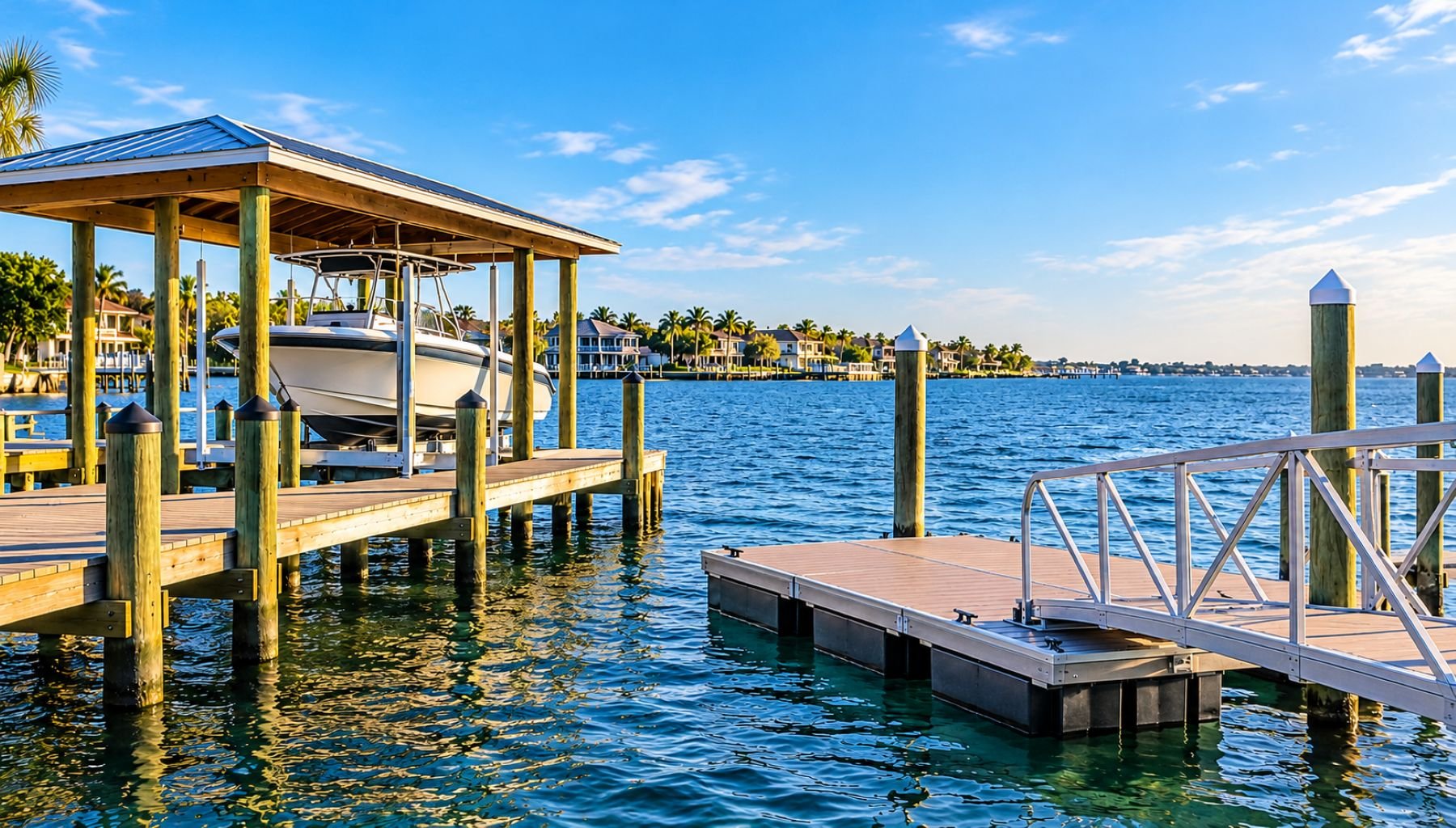
A fixed dock is built on pilings driven into the lakebed or seabed, with the deck framed at a set height above the water. That height doesn't change. Not with the tide, not with rainfall, not with the season. A floating dock instead rests on flotation, typically sealed foam-filled billets or drums, and rises and falls with the water level. It connects back to the shoreline through a hinged gangway that pivots to accommodate the changing angle.
That single structural difference, fixed elevation versus floating elevation, is what drives almost every other decision in this comparison.
When a Fixed Dock Is the Better Choice
Fixed docks tend to be the right call on Choctawhatchee Bay, Santa Rosa Sound, and most protected canals throughout the Fort Walton Beach area, where tidal swings are modest and water levels stay fairly consistent through the year. A few situations where fixed construction makes the most sense:
You're supporting a boat lift, especially a heavier one, since a fixed structure gives the lift a stable, unmoving platform to mount to
You want the dock to double as usable outdoor living space (a shaded seating area, a fish-cleaning station, storage) where a stationary deck feels like part of the yard rather than a floating platform
Your water depth stays relatively steady across seasons, so a fixed height won't strand the dock at low water or submerge it at high water
You want lower long-term maintenance, since there are no hinges, flotation billets, or moving connections to inspect after every storm
The tradeoff is upfront cost and site disruption. Driving pilings to the depth needed for a stable structure, especially in the sandy soils common along the Panhandle, takes the right equipment and, in many cases, marine-borer-resistant treated wood, vinyl, or composite piling material to hold up long-term.
When a Floating Dock Makes More Sense
Floating docks earn their keep on properties where water levels genuinely move — reservoirs, some canal systems affected by lock operations, and shorelines with steeper wave or wake exposure where a rigid structure would take a beating. Floating construction is worth considering when:
Water levels at your property fluctuate more than a foot or two through the year
You want the flexibility to add, remove, or reconfigure sections as your needs change. A floating system is generally easier to modify than a pile-supported one
Site access makes heavy pile-driving equipment impractical, since floating systems can sometimes be installed with lighter equipment
You're building a jet ski or PWC port, where floating designs integrate the port directly into the flotation system and let it ride with the water rather than fighting it
The tradeoff runs the other direction here: floating docks have more moving parts to maintain. Hinges, flotation billets, and the gangway connection all need periodic inspection, particularly after storm season, and a platform that moves underfoot isn't always what property owners picture when they imagine permanent outdoor living space.
What About Boat Lifts and Jet Ski Ports?
Both dock types can support a lift, but the details differ. Fixed docks typically pair with piling-mounted or davit-style lifts bolted directly to the structure. Floating systems more often integrate a dedicated floating lift or PWC port as part of the flotation package itself, so the lift rises and falls with the same water level as the dock around it. If a boat lift is part of your plan, that's worth deciding alongside the dock type, not after it's already built. Property Image's boat lift covers are one detail worth planning for at the same time, since retrofitting a canopy is more straightforward when it's part of the original design.
Cost and Maintenance, Side by Side
Fixed docks generally cost more upfront on sites that need extensive pile-driving, but settle into lower ongoing maintenance once built and there's simply less that can wear out. Floating docks can come in at a lower material cost for shorter spans and less invasive sites, but budget for periodic flotation and hinge inspections, especially in a storm-prone environment like the Florida Panhandle. Neither type is "cheaper" in every scenario; the honest answer depends on your specific shoreline, water depth, and how long you plan to own the property.
Permitting on the Florida Panhandle
Both fixed and floating docks typically require permitting before construction begins, whether through the Florida Department of Environmental Protection, your local building department, or the U.S. Army Corps of Engineers depending on the waterway. Requirements shift based on whether you're building on state sovereign submerged lands, a private canal, or a landlocked pond, and getting this wrong can delay a project by months. A licensed marine contractor who works these waters regularly will already know which agency needs to sign off on your specific shoreline.
Which Dock Type Is Right for Your Property?
Start with three questions: How much does your water level actually move through the year? What are you putting on the dock: a boat lift, a seating area, a jet ski port? And how exposed is your shoreline to wind and wake? The answers usually point clearly in one direction. When they don't, that's exactly the kind of site-specific call worth getting an experienced marine contractor's eyes on before you commit to a design.
Ready to talk through your shoreline? Contact Property Image or call 850.374.8203 to schedule a waterfront assessment across Fort Walton Beach, Destin, Niceville, Navarre, Miramar Beach, and the surrounding Emerald Coast.
Frequently Asked Questions
Can a fixed dock be converted to a floating dock later?
Not directly, the two are structurally different systems. Some properties use a hybrid approach, with a stationary pile-supported section transitioning to a floating finger pier, but converting an existing fixed structure to fully floating typically means starting over.
Do floating docks hold up in Fort Walton Beach's bay and canal waters?
Yes. Floating docks are common in marinas and residential canals throughout the area. The right flotation and anchoring system depends on your specific wave and wake exposure, which is something worth assessing on site rather than guessing from a catalog spec sheet.
How long does dock installation typically take?
Timelines vary with scope, permitting, and weather, but a typical residential dock project runs anywhere from one to a few weeks of on-site work once permits are in hand. Permitting itself is often the longer part of the timeline.